Why We Think and Feel Differently as Neurodivergent Adults


Understanding how our brain works:
Understanding Neurodivergent Brains in Adulthood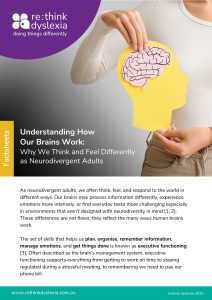
As neurodivergent adults, many of us think, feel, and respond to the world differently. Our brains may process information in unique ways, experience emotions more intensely, or find everyday tasks harder—especially in environments that aren’t designed for neurodivergent people.
These differences are not flaws. They are part of natural human diversity.
At re:think dyslexia, we help adults understand how their brains work so they can access the right tools, supports, and environments to thrive.
How Our Brain’s “Management System” Works
A key part of how we think and function is called executive functioning.
Executive functioning is the set of brain skills that help us:
- Plan and organise
- Remember information
- Manage emotions
- Start and finish tasks
- Manage time and focus
You can think of executive functioning as the brain’s management system. It helps with everything from getting to work on time, to staying calm in a stressful meeting, to remembering to pay a bill.
Many neurodivergent adults experience challenges in executive functioning, not because of intelligence or effort, but because their brains work differently.
Key Executive Functioning Skills
Executive functioning includes skills such as:
- Working memory – holding and using information short‑term
- Cognitive flexibility – adapting to change or shifting focus
- Inhibitory control – managing impulses and self‑regulation
- Task initiation and completion – starting and finishing tasks
- Planning and organisation – breaking tasks into steps
- Time management – estimating time and meeting deadlines
- Emotional regulation – managing feelings in the moment
Challenges in these areas are common across many neurodivergent experiences.
How Neurodivergent Conditions Can Affect Executive Functioning
Autism
(Autism Spectrum Disorder)
Autism affects how the brain works and how a person experiences the world.
Autistic adults may:
- Prefer routines and find transitions challenging
- Experience sensory or emotional overload that leads to shutdowns
- Struggle with time perception or long‑term planning
- Use repetition or intense focus as coping strategies
- Feelings of burnout
These differences are part of how autistic people experience the world, but they can be misunderstood in workplaces and education settings.
ADHD
(Attention-Deficit/Hyperactivity Disorder)
ADHD affects how the brain regulates attention, motivation, and effort.
Adults with ADHD may:
- Be easily distracted or lose track of time
- Miss deadlines despite strong intentions
- Have high energy in body or mind
- Experience impulsivity in actions or speech
- Have strong ideas and creativity, but struggle to complete tasks
- Experience emotional intensity or mood changes
ADHD is not a lack of discipline it’s a difference in how the brain responds to stimulation.
Specific Learning Disabilities /Difficulties
(Dyslexia, Dysgraphia, Dyscalculia)
These conditions can affect reading, writing, maths, and executive functioning skills.
Adults with Specific Learning disabilities may:
- Struggle to follow multi‑step instructions
- Find it hard to hold verbal or written information in mind
- Take longer to read and organise thoughts into writing
- Processing written information is slower
Because these differences are often hidden in adulthood, many people experience stress, fatigue, and burnout, especially at work or in their studies.
Signs Your Brain Might Be Struggling

You might notice:
- Feeling constantly behind or overwhelmed
- Difficulty starting or finishing tasks
- Forgetting appointments or losing things
- Emotional outbursts or shutdowns under stress
- Trouble managing multiple responsibilities
- Difficulty adapting to change
- Half‑completed tasks due to distraction
These signs are signals not failures.
Tips to Help At Work or Study
Helpful strategies include:
- Digital calendars, reminders, and task apps
- Breaking tasks into small, clear steps
- Visual checklists and colour‑coding
- Quiet spaces and reduced sensory distractions
- Clear layouts using headings and dot points
- Regular breaks to reset focus
- Assistive technology, apps, and AI tools for reading and writing
Tips to Help in Daily Life
You may find it helpful to:
- Use routines and visual cues
- Set realistic expectations and practise self‑compassion
- Use timers or visual clocks
- Use AI tools like Siri, text-to-speech, and speech-to-text
- Delegate or outsource draining tasks
- Prioritise sleep, movement, and nutrition
- Reduce alcohol and other substances
- Set boundaries to conserve energy
- Access counselling or psychological support
Strengths of Neurodivergent Brains
Having a brain that works differently also brings powerful strengths, including:
- Hyperfocus on areas of interest
- Creative and innovative thinking
- Strong problem‑solving skills
- Direct and clear communication
- Empathy and authenticity
- Resilience built through navigating non‑inclusive systems
Executive functioning challenges are not a sign of failure; they are often a sign that environments need to change.
You’re Not Alone – Support Is Available
re:think dyslexia offers guidance, care, and connection for neurodivergent adults.
📞 Free Confidential Helpline: 1800 13 NEAP (6327)
📧 Email: [email protected]
Our mental health consultants can help you understand your needs and access the right supports.
Download the Factsheet Why We Think and Feel Differently as neurodivergent adults March 2026
Co-developed with our Lived Experience and Subject Matter Advisors
This Factsheet has been developed by the re:think dyslexia clinical team and reviewed by our Lived Experience and Subject Matter Advisory committee, including:
Lived Experience Advisors
- Jacqualine Middleton
- Danielle Harvey
Subject Matter Advisor
- Dr Bec Marland, Victoria University
Our Resource and Further Support
Our Resource
- Understanding Neurodivergence Factsheet
- Neurodivergence Mental Health Factsheet
- Inclusive Workplaces: An Employee’s Guide to Psychosocial Wellbeing in the Workplace
- Neurodivergent Adults and Self-regulation Factsheet
- Neurodivergence and Burnout Guide
- Dear Dyslexic Podcast Series
External Supports
- Speak with a mental health professional (your GP can provide a referral)
- JobAccess Australia
Urgent Supports
- Lifeline:13 11 14
- 13YARN: 13 92 76 | 24 /7 Crisis support for Aboriginal and Torres Strait Islanders
- Beyond Blue: 1300 224 636
Recommended Resources
- Self-Care for Autistic People — Dr Megan Anna Neff
- The Neurodivergent Skills Workbook for Autism and ADHD — Jennifer Kemp, Monique Mitchelson and Sonny Jane Wise
- How to Thrive with Adult ADHD – Dr James Kustow
- Executive Functioning Workbook for Adults – Dr Blythe Grossberg
References
1. Lonergan, A., et al., A meta-analysis of executive functioning in dyslexia with consideration of the impact of comorbid ADHD. Journal of Cognitive Psychology, 2019. 31(7): p. 725–749.
2. Pozo-Rodríguez, M., et al., A systematic review on the association between executive function and emotional regulation in autism, ADHD, and autism/ADHD. Neuroscience & Biobehavioral Reviews, 2026. 183: p. 106570.
3. Mareva, S., et al., Mapping neurodevelopmental diversity in executive function. Cortex, 2024. 172: p. 204–221.
4. Diamond, A., Executive functions. Annu Rev Psychol, 2013. 64: p. 135–68.
5. Johnston, K., et al., Executive Function: Cognition and Behaviour in Adults with Autism Spectrum Disorders (ASD). J Autism Dev Disord, 2019. 49(10): p. 4181–4192.
6. Demetriou, E.A., et al., Autism spectrum disorders: a meta-analysis of executive function. Molecular Psychiatry, 2018. 23(5): p. 1198–1204.
7. Grossberg, B., Executive Functioning Workbook for Adults. 2022, Illinois: Callisto Publishing.
8. Sharfi, K., S. Rosenblum, and S. Meyer, Relationships between executive functions and sensory patterns among adults with specific learning disabilities as reflected in their daily functioning. PLoS One, 2022. 17(4): p. e0266385.
9. Smith-Spark, J.H., et al., Executive functions in adults with developmental dyslexia. Research in Developmental Disabilities, 2016. 53-54: p. 323–341.
10. Kustow, J., How to Thrive with Adult ADHD: 7 Pillars for Focus, Productivity and Balance. 2024, London Ebury Publishing. 336.
11. Wissell, S., Dyslexia: Insights into the hidden disability in and out of the workplace. 2024, Melbourne: KMD Books. 280.
12. Miserandios, C., . The Spoon Theory: Byt you dont look sick. 2003, Lymphoma Action: Aylesbury. p. 3.
13. Barkley, R.A., Benton, C Taking Charge of Adult ADHD. 2022, London: Guilford Press.